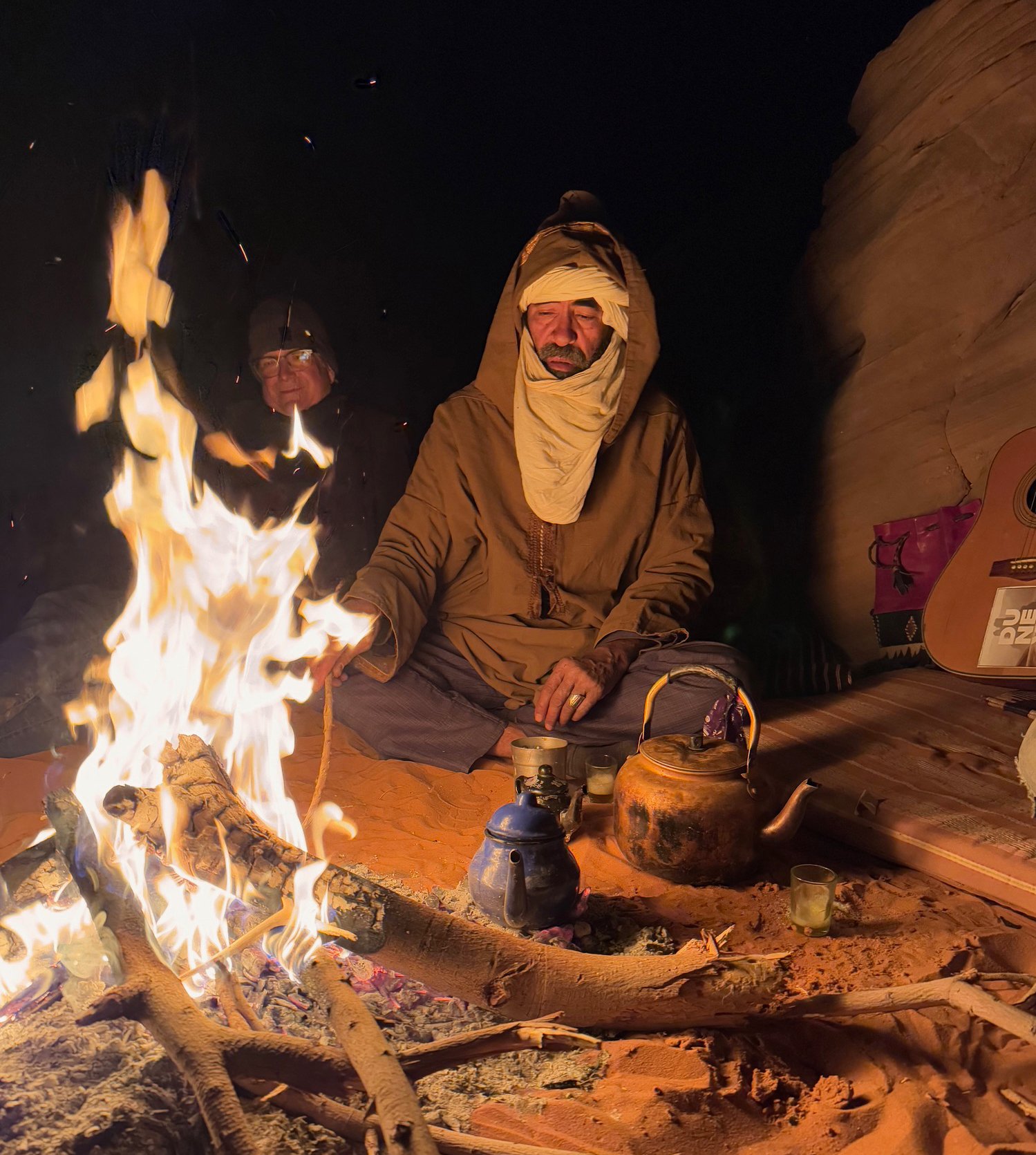
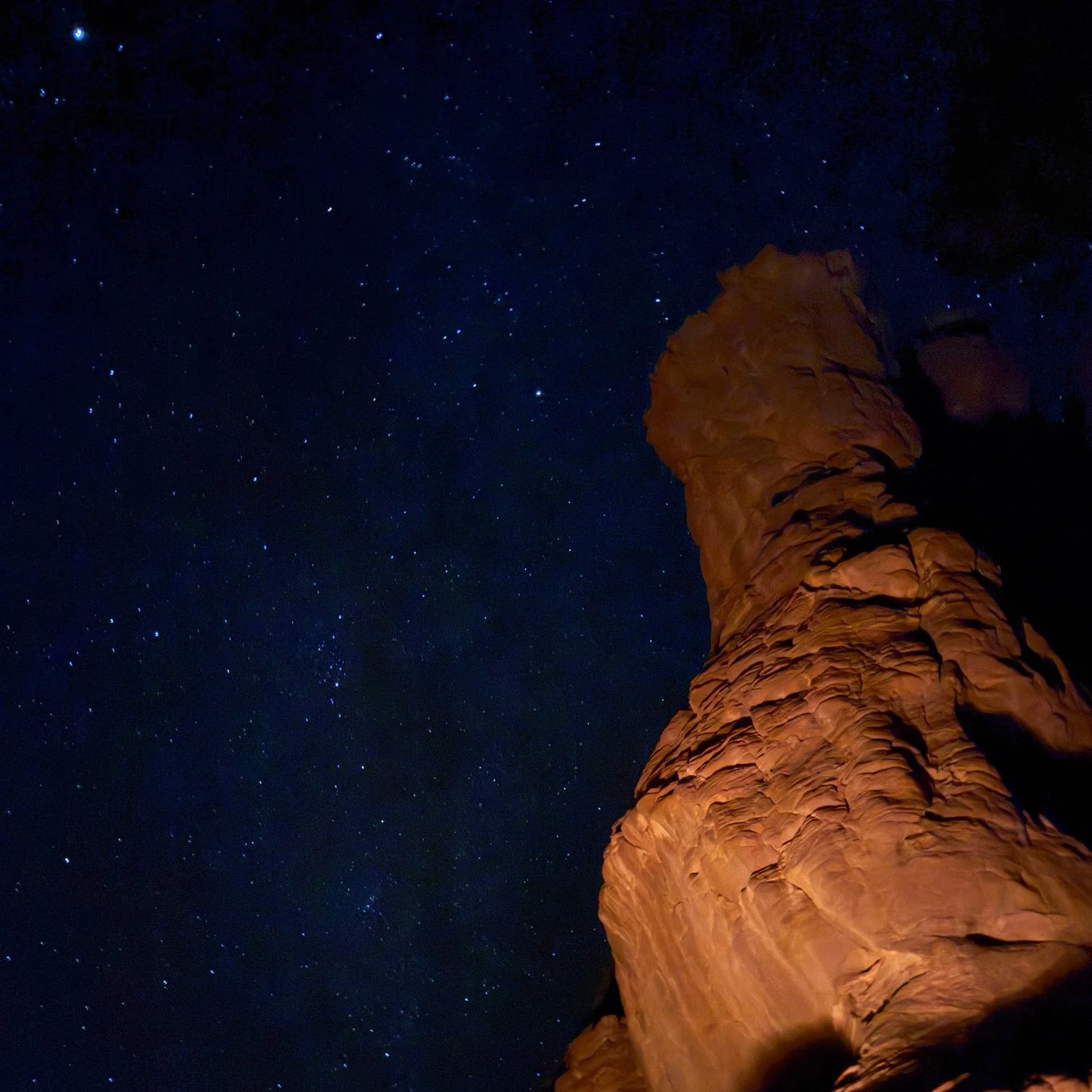
I lean back against the bare rock and look up at the Milky Way, hanging like a blast of gunshot in the Saharan sky. Brahim, my guide, points out Cassiopeia, named for the vain Ethiopian queen, which dazzles with luminescent nebulae and the shock waves of a starburst galaxy; then, Amanar, or Orion, the warrior of the desert, with its sapphire-coloured supergiant, 1,200 light-years away; and, finally, Polaris, the steadfast North Star, which the Tuareg have used for navigation for centuries. Shooting stars flash across our retinas; and the International Space Station traces a fine white arc across Ursa Major, 400 kilometres above our heads.
We are standing in the lee of a sandstone pinnacle – its wind-weathered strata appearing like melting wax in the flickering light of our campfire. This is the so-called Cirques, a surreal land of sculpted buttes and plateaus at the heart of Tadrart Rouge, the Red Mountains of Algeria’s Tassili n’Ajjer National Park. It has taken our diminutive caravan of six travellers and six Targi, the nomads native to these lands, nearly a week to get here from the desert town of Djanet – and, like the astronauts in that space station, I find myself untethered by the experience.
How did I get here? It started over a year ago when I became mesmerised by a series of sepia-tinted Instagram reels featuring serirs, sand sheets, dunes and ergs, posted against a hypnotic soundtrack of desert blues by Chahira Ouanella on her Duneya Tours account. Overwhelmed by deadlines, I dreamed of retreating to the simplicity of sand, weather and rock, where every day heralds a different late-Turner landscape of endless peachy browns beneath a clean blue sky. For months, I found myself tuning in for a microdose of daily awe. I sent a message; and eventually we spoke on the phone. I learnt that Chahira and her husband Adasay were diaspora babies from Canada and Switzerland who had returned to Algeria to start a travel company. “No one in Djanet can believe we’re here, but it feels natural for us,” she said. Adasay’s great uncle opened Djanet’s first tour agency, and the family has been guiding trips for three generations. Even his Swiss mother is an intrepid desert traveller, having met Adasay’s father on a camel trek in the 1970s. Chahira and Adasay’s desire to dispel misconceptions about Algeria – and the Tuareg – was palpable even over the patchy phone line. I booked a flight.
As I come into land, Djanet appears from the darkness like a golden tear strung along the Oued Idjeriou river. In the morning, the waterway turns a vibrant green, a shock against the rust red mountains that surround the town, which sits 1,050 metres high on a shelf of the Tassili n’Ajjer, or Plateau of Rivers. The plateau is twice the size of Switzerland and shelters 14 Kel Ajjer clans. Djanet was an important stop on ancient trade routes, later finding itself a flashpoint between competing Ottoman and French imperialism. The Kel Ajjer held sway until 1920 when the French finally subdued the area, concluding a process of Algerian colonisation that began in 1830. While Djanet has a population of just 23,000, there are an estimated 1.2 to 3 million Tuareg in seven confederations scattered across Libya, Niger, Mali and Burkina Faso – a nomadic people now penned in by modern borders.
Adasay knows everyone in Djanet’s market, so we browse slowly, admiring a takatkat, or overshirt, made from bazin, a waxed damask from Mali’s capital Bamako (“it’s the fashion these days as it shines in the sun,” Adasay tells us), alongside ornamented leather bags, belts, sandals and other accessories. Shops are piled high with spices, dried herbs and pretty floral print fabrics used as melhfas (a wrap worn by local women), as well as elegant woven bowls, baskets and handbags. Adasay points out round palm mats woven in a colourful spiral, traditionally used to wrap salt cakes for transportation on camels – a practice still common on the caravans headed to salt mines in Bilma, Niger. We collect his repaired tea bag from the leathersmith, buy some spices to enliven our desert meals and invest in a sheer sheesh, the signature head veil worn by Tuareg men.
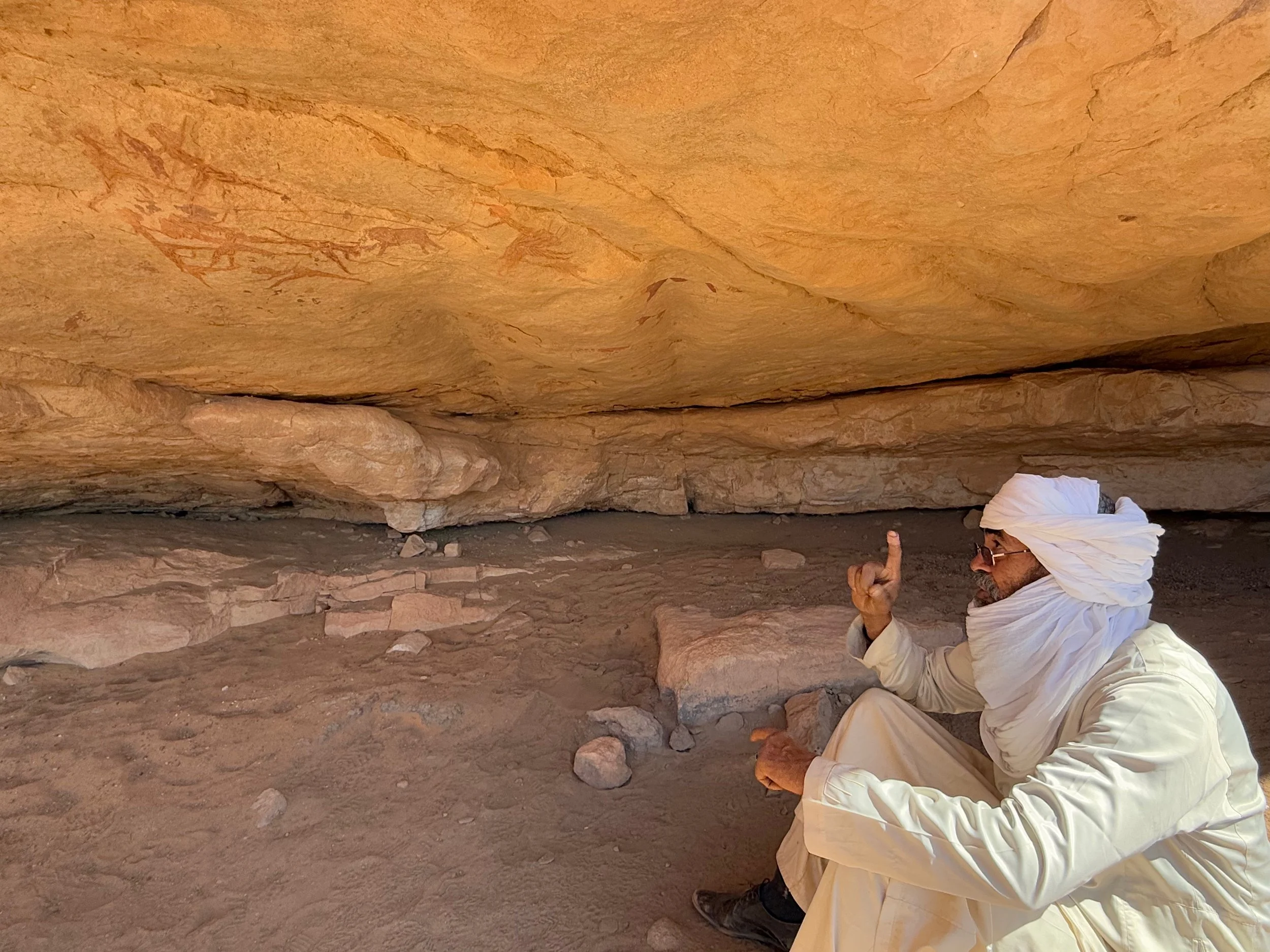
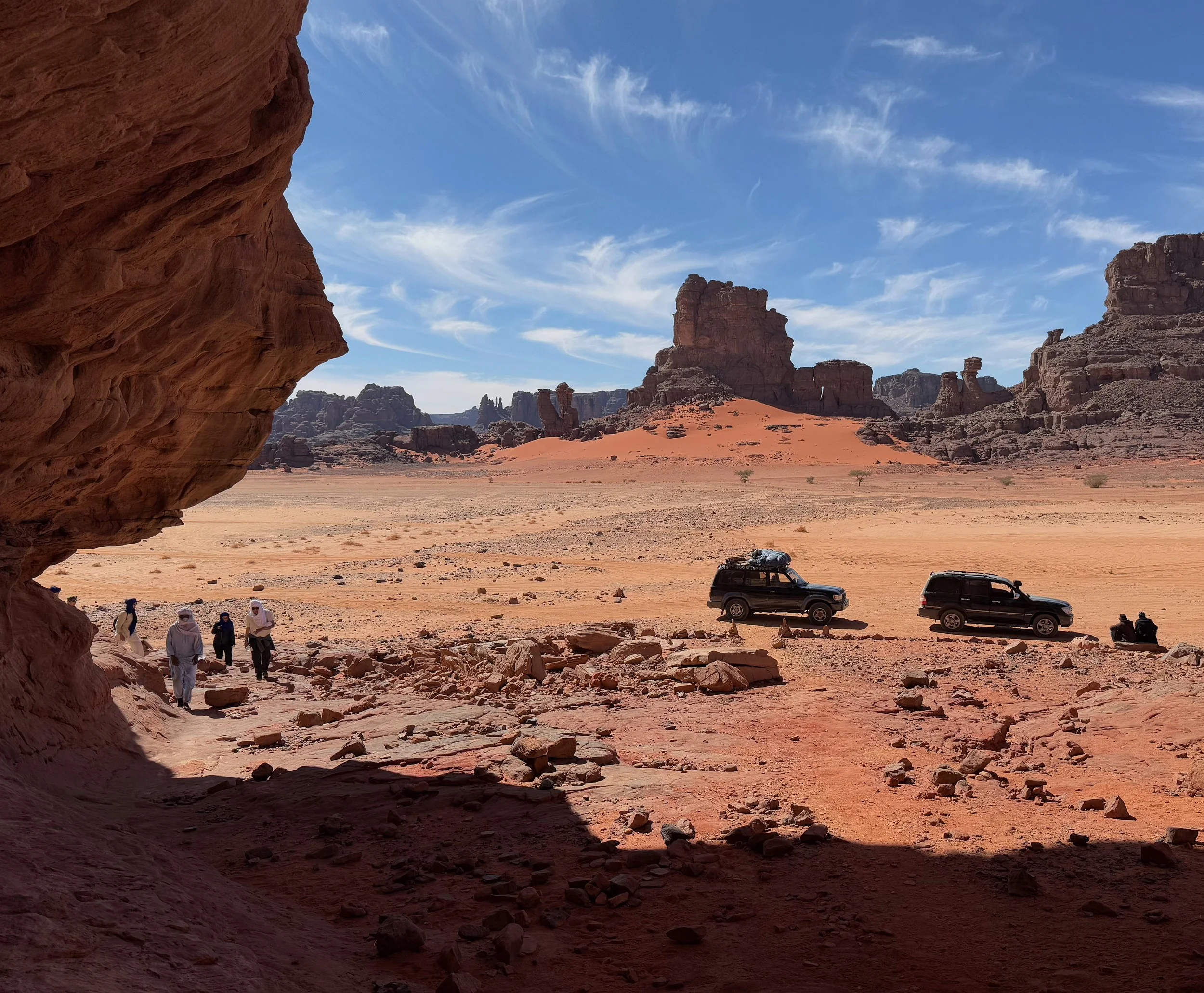
Heading out of Djanet, we trace the edge of the Tassili n’Ajjer plateau, which glints like an iron curtain beneath a layer of ferromanganese (an alloy known as desert varnish), and pass a herd of white mehari camels, the Tuareg’s pride and joy. When we stop for lunch, Adasay’s uncle Brahim leads us halfway up the black escarpment to a rock shelter, to show us a bright ochre-coloured painting of leaping, long-haired hunters encircling a lion. He picks up a ferrous rock and scratches away at it, showing how the pigment for the painting might have been made, then fixed with blood or urine to the rock face. We are amazed by the little tableau, because we have no sense yet of what lies ahead.
Over the next few days, our personalities begin to reveal themselves. There’s Pelle, the adventurous engineer with his orange neck gaiter and yellow cap who is always the first up the cliffs and dunes, followed by gentle and curious Charlene, a special needs teacher. Stalwart Tassa, from San Diego, is an earnest student of Islam and Arabic, newly married to Fadwa, an Algerian who grew up camping all over California with her sisters, but tells us: “I’m the first person in my entire extended Algerian family to set foot in this place.” She becomes our translator and cultural interpreter, even though she, too, finds herself a stranger in this place.
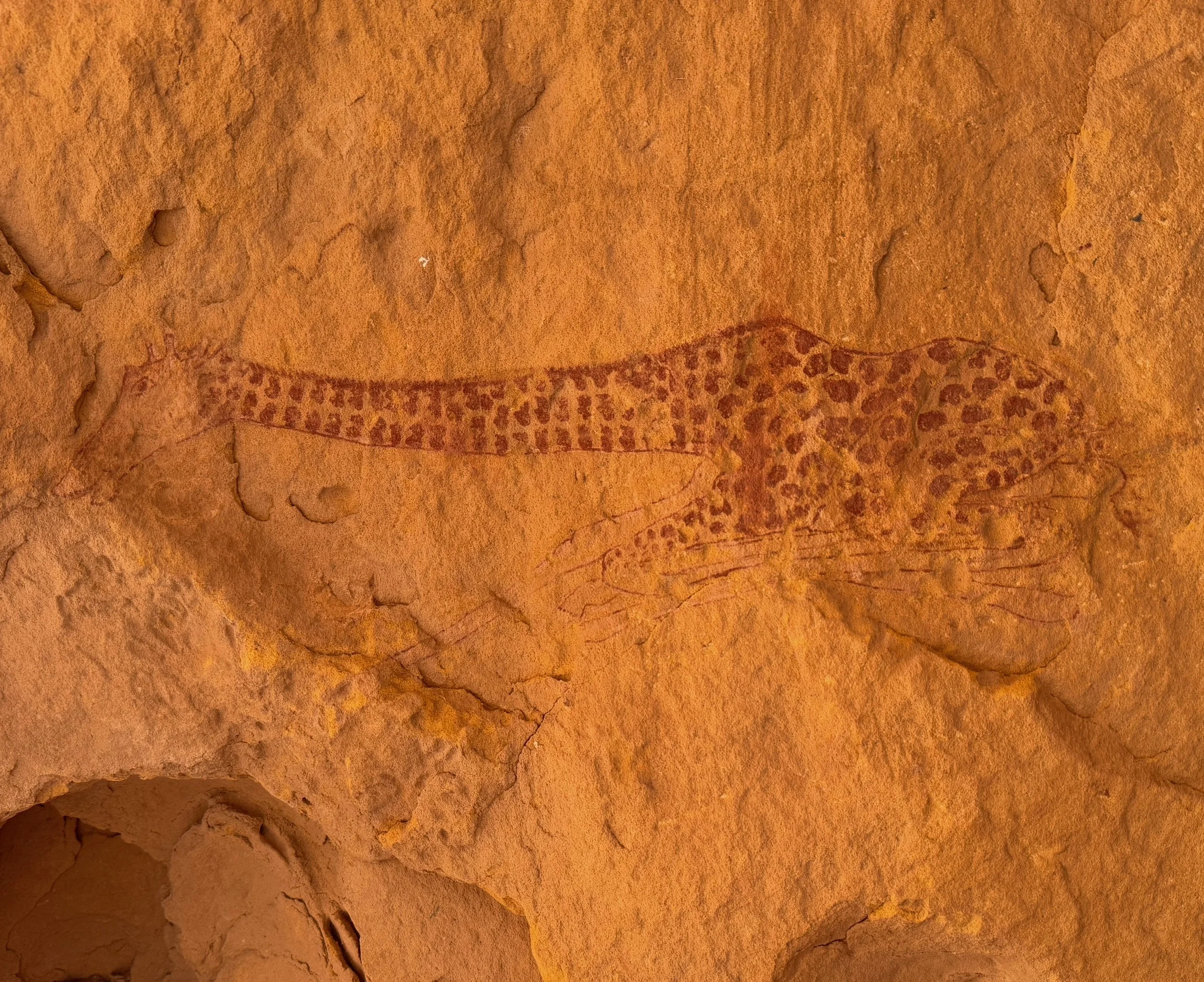
Between 5,500 and 11,700 years ago, In Djaren was the centre of a thriving culture, its cliffs covered in paintings and petroglyphs. While Europe shivered under an Ice Age, the Sahara was basking in the Neolithic Subpluvial period, which conjured comfortable climes where abundant grasslands were watered by monsoon rains and great paleo lakes supported an array of wildlife. One morning, Brahim leads us to a large, flat slab chiselled, extraordinarily, with the image of an elephant. Above it, an inscription in the Tuareg language, tifinagh, hints at the deep connection between the Tuareg and their Amazigh cousins further north. We move on to a weathered rhino and a perfectly painted picture of a giraffe giving birth that is so finely rendered, I find it impossible to believe it is 10,000 years old.
While the morning is spent roaming the vast valley beneath chiffon clouds and climbing up stratified cliffs to blink in disbelief at every new prehistoric artwork, the afternoon is spent snoozing in the sun like lizards, or fossicking for fossils and pieces of prehistoric pottery. Then we climb back into our Land Cruisers and fishtail down In Djaren’s tributaries amid huge puffs of sand that leave Brahim exclaiming “poudre!” and whooping in delight to the sounds of Tinariwen. They are the original ‘Desert Boys’ who formed their band in Ghaddafi’s military training camps in the 1970s and traversed Tassili to the battlefront of northern Mali and Niger during the Tuareg rebellion in 1990.
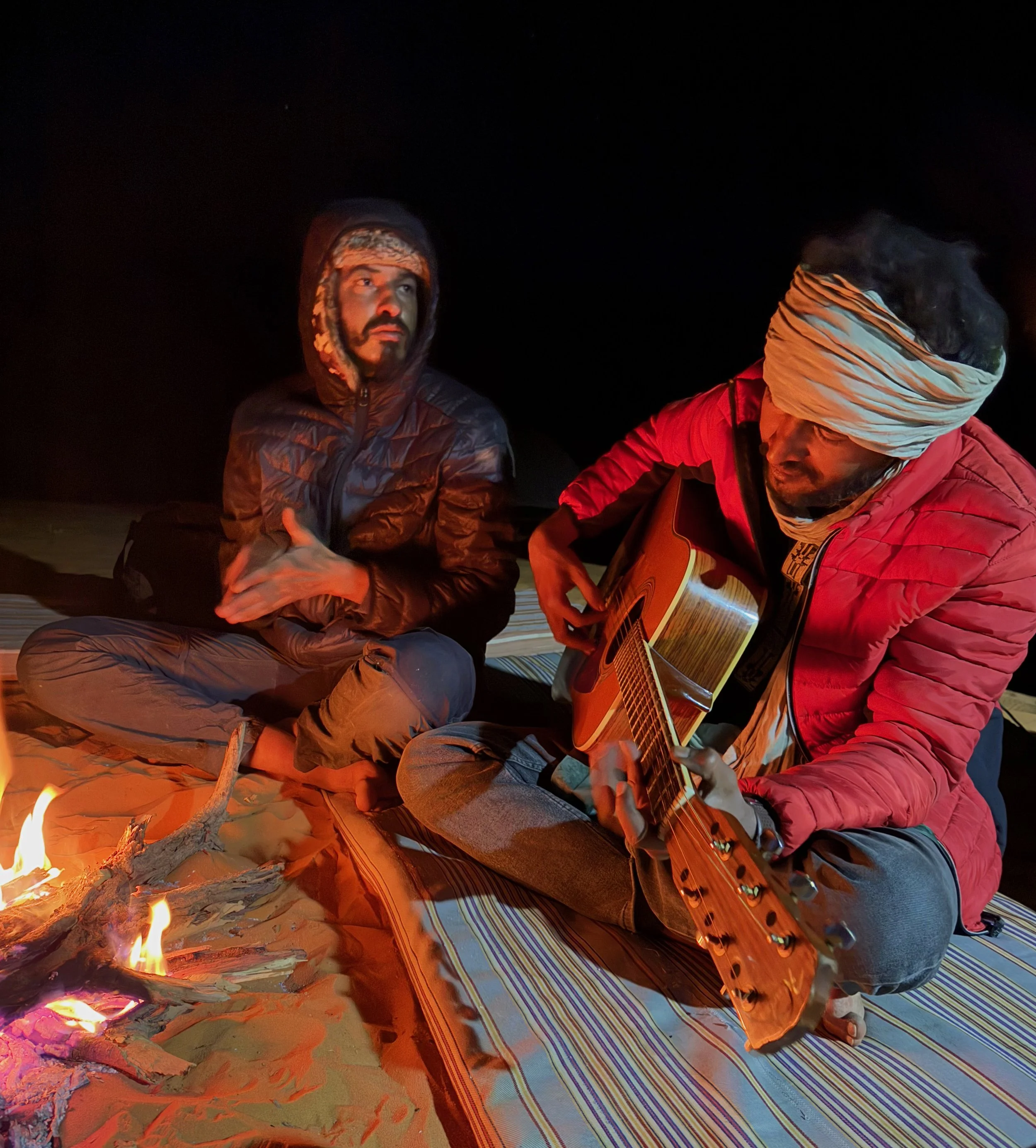
Their music, assouf, is rooted in the traditional beat of the tendé drum and the inflections of the teherdent (a three-stringed lute) played by the West African poets and storytellers, or griots, of the Niger Bend. These are substituted around our campfire by a plastic water drum and Boutafil’s acoustic guitar which he wears around his black ‘Planet Djanet’ t-shirt and red puffa jacket while he sings lyrical poems about the desert, dispossession and ishumar, the marginalised young men forced to confront the alien realities of modern nation-states dislocated from the old customs and ethnic allegiances that previously gave life dignity. The music seems to seep into the sand, the rising moon and stars, like a tuning fork emitting a fundamental frequency that holds us together in the profound darkness.
A study of Tassili’s rock art didn’t take place until 1956, when amateur French anthropologist Henri Lhote arrived. He documented 800 paintings, writing that he had never seen anything “so extraordinary, so original, so beautiful”. But Lhote and other early explorers weren’t responsible custodians or careful reporters, indulging in damaging practices such as wetting the paintings to secure more vivid photographs, or spreading outlandish theories that extraterrestrials had created them. Since then, 15,000 paintings and engravings have been found and, in the 1980s, Tassili n’Ajjer was recognised as a Unesco Heritage site of outstanding universal value.
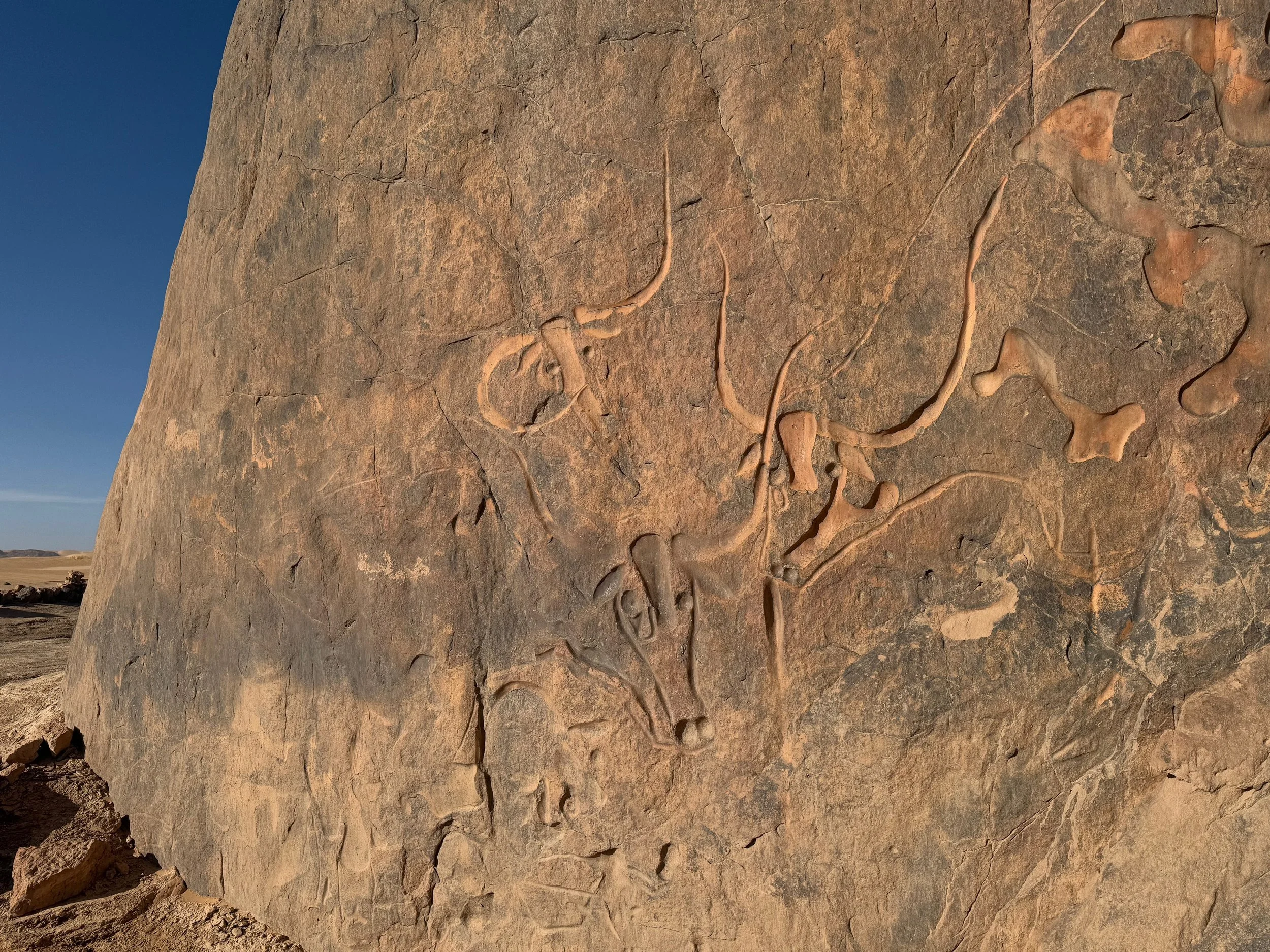
There is no doubt that the artworks are exceptional, but they are also a unique record of the Earth’s changing climate – and a stark warning of how once extravagantly fertile landscapes can be ravaged in the blink of a cosmic eye. We witness the change take place as we skip from Wild Fauna Period engravings (10,000-6000 BCE) of stampeding elephants, rhinos and even hippos; to the Round Head Period (8000-6000 BCE) of mystical dancers and toolmakers; to the Pastoral Period (5500-2000 BCE), where the images are full of spear-wielding warriors and longhorned aurochs, the predecessors of the zebu cattle that still graze the Sahel. So beloved are these creatures that they are chiselled across monumental stone slabs, or carefully painted in their dozens in secret corners of caves. At times, the Tuareg seem like prophets from another age, come to warn us of the ravages of impending climate change.
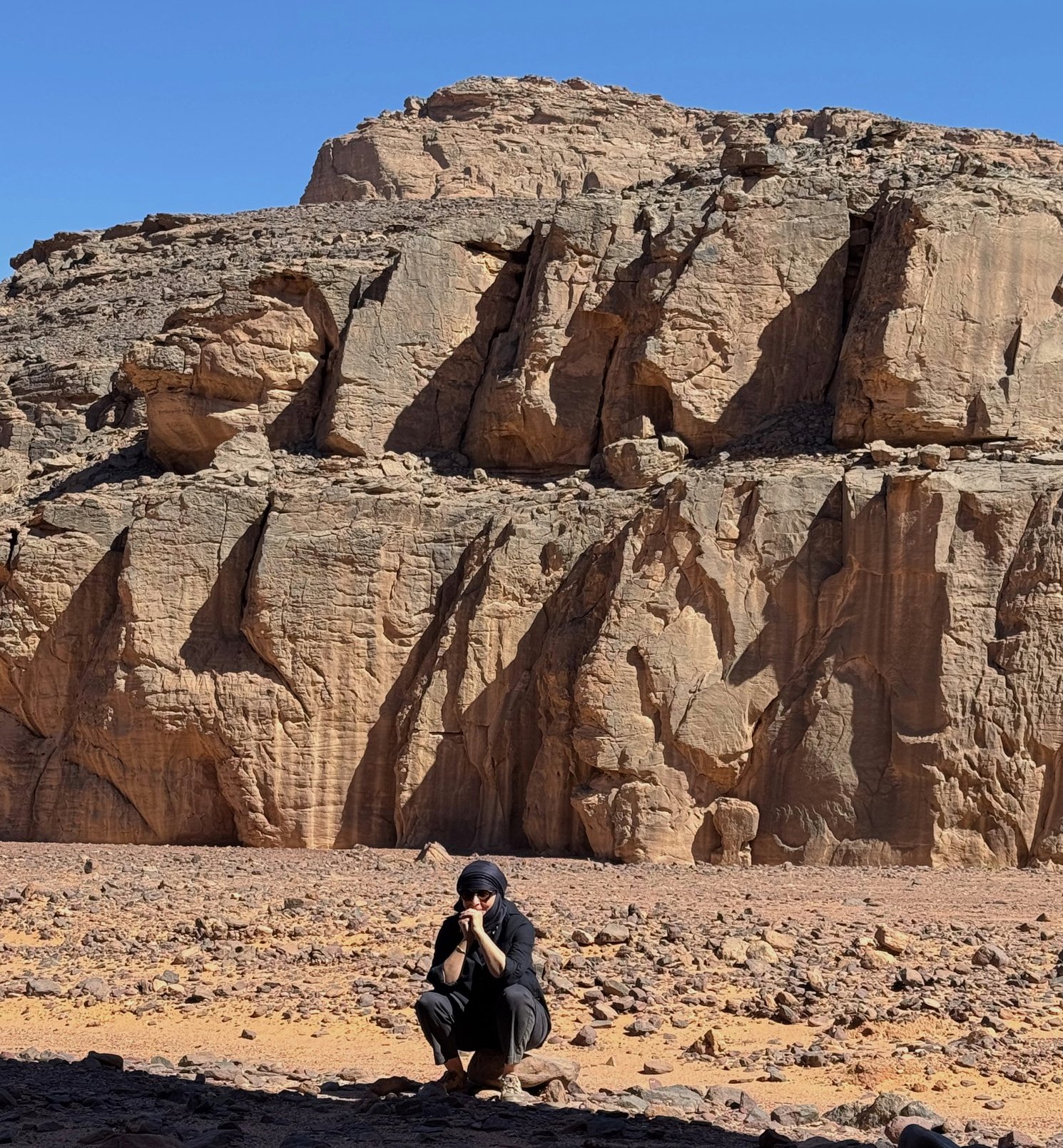
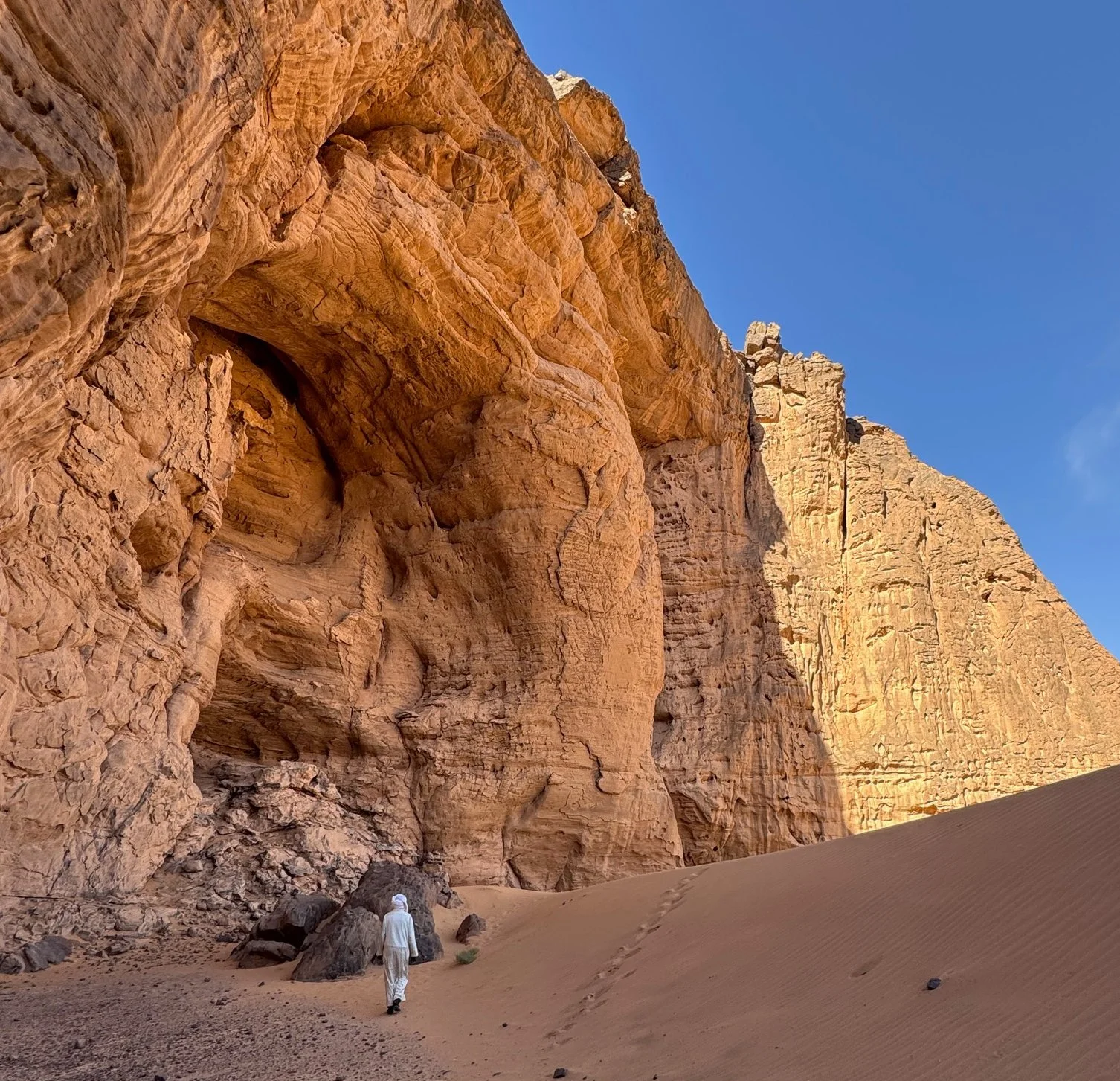
The rock art isn’t the only surprise – Tadrart, too, is an epiphany. The Precambrian plateau dates from earth’s earliest era, when continents were formed, life evolved and volcanoes and mass extinction events shaped our world. In places it is scorched and desolate as if recently blasted by a solar flare. Elsewhere we stand amid immense amphitheatres of striated rocks wind weathered into surreal shapes or gaze up at petrified volcanic vents created by pyroclastic blasts that once shot magma and frothy scoria skyward. We pick up pieces of the petrified basalt frozen like bath bubbles for all eternity. Sometimes it’s hard to fight the feeling that we’re pioneers who’ve journeyed back to the beginning of time, but then we crest a hill or round a corner and find ourselves in a fertile river bed full of alfalfa grass, acacia trees and great bushes bursting with yellow and purple flowers over which flit butterlies and birds. And, we’re reminded that we’ve just circled back to a well-trodden path as the rock art and pottery proves.
After three days of travelling together we find ourselves tight knit, following in Brahim’s footsteps. It’s like we’ve been travelling together for years united by our reliance on each other for everything – food, laughter, music, patience, strength and compassion. While each day starts immaculately with an arc of airglow at the horizon before the sun spills its light across the stunning panorama, it ends in the comforting sight of human faces illuminated by firelight. Drinking endless cups of tea in Tadrart our lives seem inexpressibly trivial and momentous all at once. We each matter greatly, but not at all. The desert gifts us this clarity and community because everything else is stripped away.
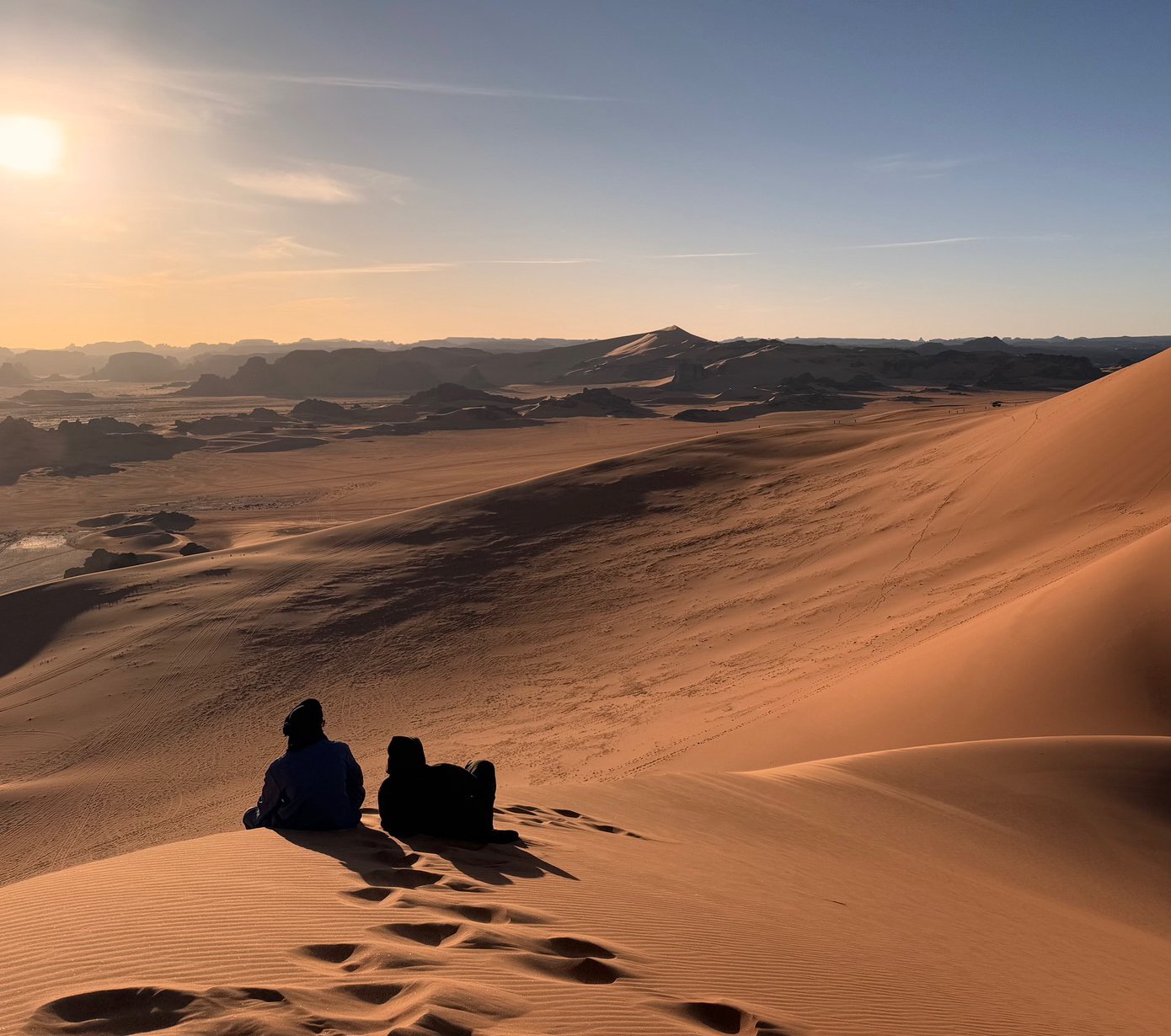
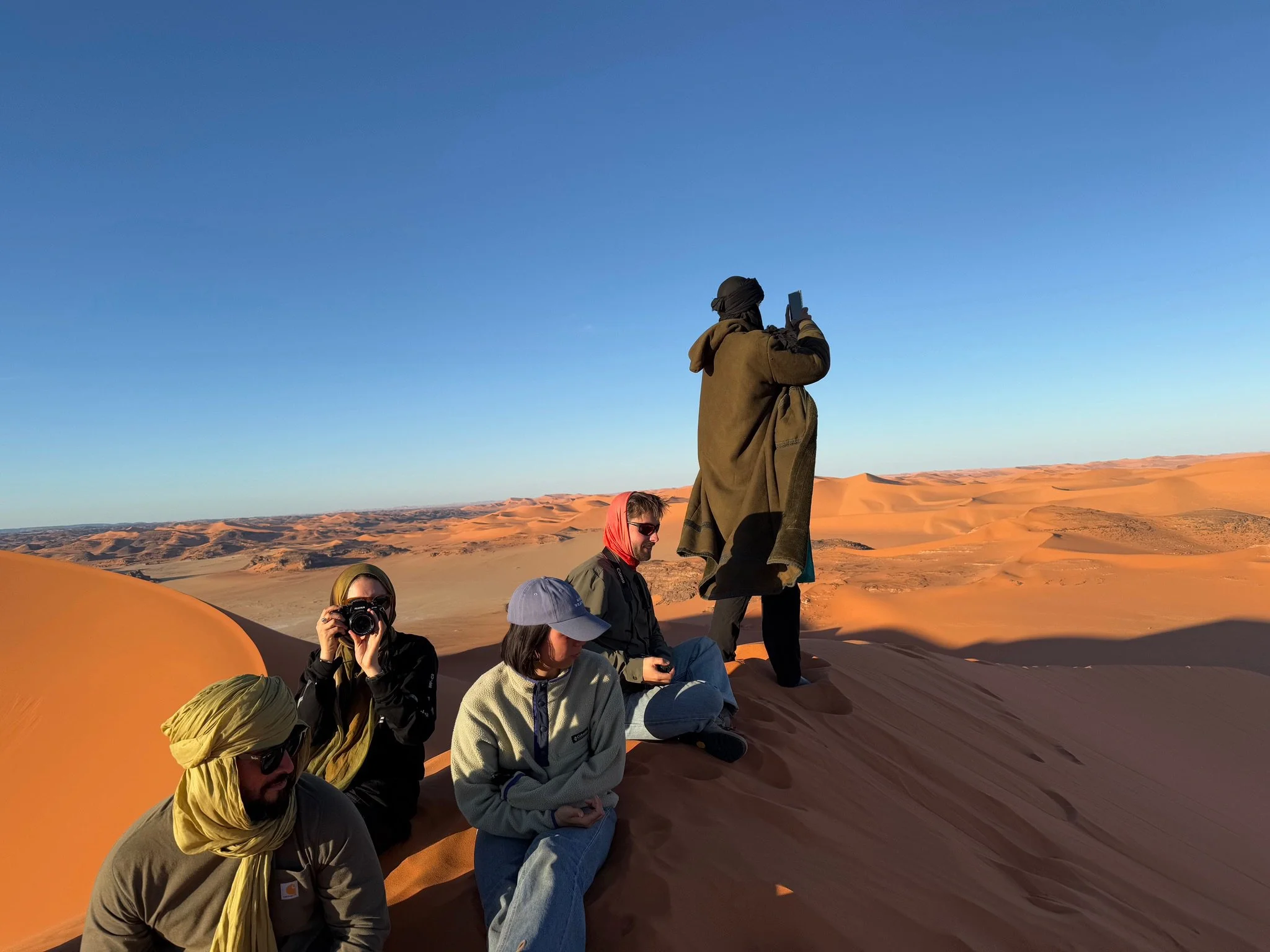
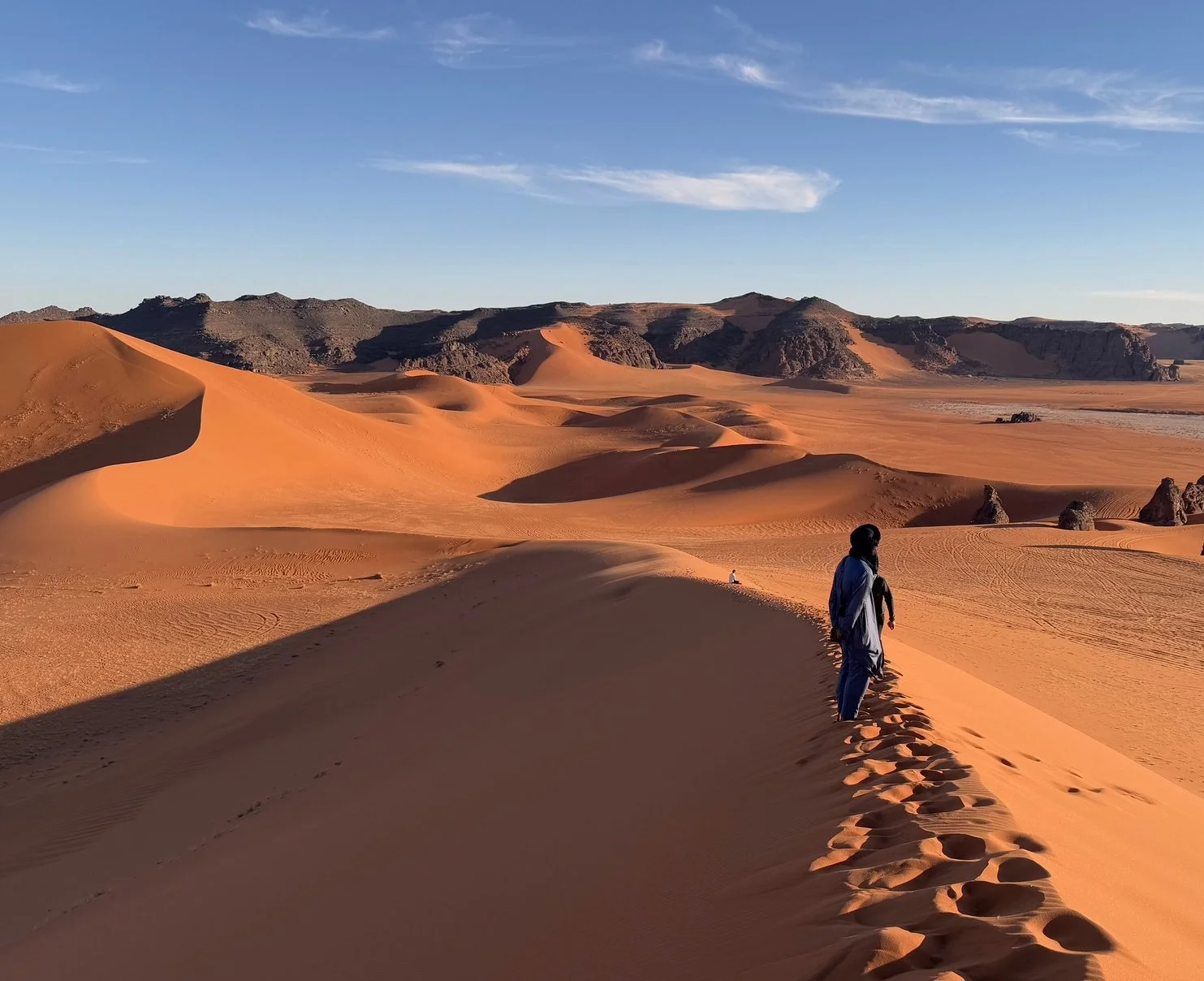
Finally, on the penultimate afternoon, we break out of Tadrart’s rocky embrace and launch into an ocean of silky sand that washes across the border into Libya. The Kel Ajjer have kin there, in Ghat, 100km due east on the caravan route that once traced a path from the Gulf of Guinea all the way to the Red Sea. ‘The last caravan I can remember was my father’s when he travelled to Ghat for a family wedding 60 years ago,’ Brahim tells us. Our camp that night is the most beautiful yet, set in the lee of an immense barchan dune called Tin Merzouga that rises to 304m and is one of the highest in the Sahara. Small puffs of wind lift the sand off its razor-sharp ridge filling the air with grains of quartz glitter. We start to climb in the hope of making the summit before sun fall.
Up in the space station the astronauts experience 16 sunsets a day, but here in Tadrart we live each moment slowly and fully. While they float in zero gravity, we are firmly grounded in our bodies, the avalanche of thoughts quieted, our muscles straining to ascend the moving mountain. Along the way, we notice every detail, the tracks of the smallest scarab beetle, the faintest cool breeze and the deepening colour of the sky from blue to bruised azure, then mauve and indigo. It takes me 45 minutes to reach the summit, where Pelle, Charlene, Tassa, Fadwa, Adasay and Brahim greet me with a cheer. We look around us, staggered by the beauty of it all. You don’t need to travel to space to experience the wonder of the world, Tadrart Rouge is far enough.
This piece was first published by Conde Nast Traveller Middle East in March 2026 (online in April 2026).